Ninja CrushBOSS 3-in-1 Kitchen System: A Comprehensive Breakdown of Capabilities, Performance, and Value
Home cooks seeking to streamline their countertop setups frequently face a classic dilemma: purchasing separate appliances for high-speed blending, multi-purpose food processing, and single-serve drink preparation, or settling for a compromise device that does none of these tasks particularly well. The Ninja CrushBOSS enters the market as a direct answer to this challenge, integrating three distinct vessel systems into a single, high-torque motor base. Driven by a 1,200-watt engine, the system attempts to serve as a comprehensive kitchen workhorse capable of everything from dicing vegetables and kneading dough to pulverizing frozen fruit and crushing ice for on-the-go beverages.
While the prospect of consolidating three major kitchen tools into one appliance offers clear financial and space-saving advantages, managing a broad ecosystem of blades, discs, and containers introduces distinct operational and storage considerations. Understanding how the CrushBOSS performs across its various functions helps clarify whether this multi-vessel system delivers true practical utility for daily food preparation.
Design, Hardware Architecture, and Core Features
At the center of the Ninja CrushBOSS system is a heavy-duty motor base delivering up to 1,200 watts of power. To manage the high torque generated during heavy blending and food processing cycles, the base features integrated suction-cup feet that anchor the machine securely to countertops. The control panel provides a combination of automated and manual operation modes, centered around three main program settings: SmoothSense, PrepIQ, and Custom manual speed controls.
The SmoothSense program relies on intelligent load detection to monitor resistance within the blending container. By sensing the proportion of solids to liquids, the system automatically adjusts operational speed, pausing and pulsing to draw tough ingredients down toward the blades without requiring continuous manual intervention. PrepIQ provides pre-programmed timing patterns tailored to specific prep tasks, while Custom mode allows users direct manual control over processing duration and speed.
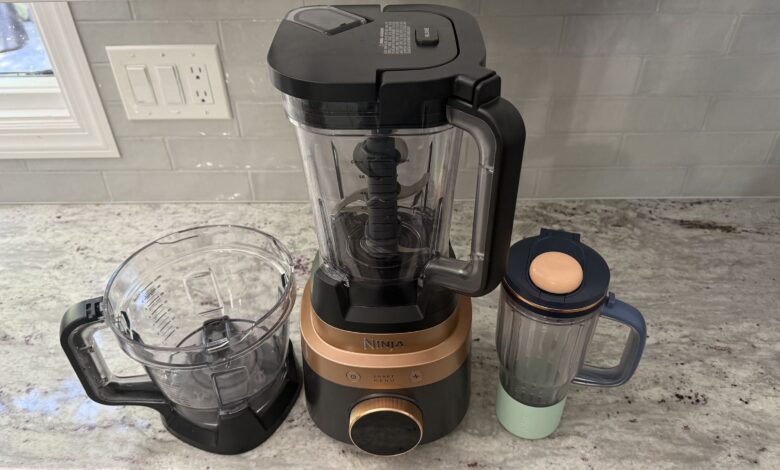
All three inclusion vessels are constructed from durable, BPA-free plastic and lock into the base using a turn-and-click safety mechanism. The primary vessels include:
- 72-Ounce Blending Pitcher: Designed for large-batch beverages, soups, and purees. It utilizes a removable stacked tower blade assembly and features a fitted lid equipped with an integrated pour spout and pop-up cap for clean dispensing.
- 64-Ounce Food Processing Bowl: Engineered for chopping, slicing, dicing, shredding, and dough mixing. It features a top-mounted feed chute, food pusher, central chopping blade, dedicated dough blade, and a drive post for multi-blade disc attachments.
- 26-Ounce Single-Serve Tumbler: A compact vessel tailored for individual smoothies, protein shakes, and frozen drinks. It pairs directly with an inverted blade lid for blending and includes a travel sipping lid with a reusable straw.
Vessel Specifications and Attachment Overview
To help visualize how the system divides tasks across its components, the core hardware specifications and vessel capabilities are structured below:
| Vessel Type | Container Capacity | Primary Accessories & Attachments | Target Kitchen Applications |
|---|---|---|---|
| Full-Sized Pitcher | 72 Ounces | Stacked tower blade assembly, pour spout lid | Large-batch smoothies, frozen drinks, pureed soups, batch iced beverages |
| Food Processor Bowl | 64 Ounces | Chopping blade, dough blade, multi-blade disc, feed chute lid & pusher | Vegetable dicing/slicing, cheese shredding, dough kneading, hummus, oat flour |
| Single-Serve Tumbler | 26 Ounces | Inverted blade assembly, travel sipping lid, drinking straw | Personal smoothies, protein shakes, slushies, fine seed/nut prep for frozen treats |
In addition to the standard blades, the food processor bowl supports a series of specialized multi-blade disc attachments. Depending on the selected configuration, these attachments enable thin slicing, thick slicing, shredding, crinkle-cutting, french fry cutting, and julienne slicing directly through the lid chute.
Food Processing Performance: Slicing, Dicing, and Prep Work
In practical food preparation tasks, the food processing module of the CrushBOSS demonstrates rapid cutting speeds. When using the multi-blade disc for specialty cuts—such as crinkle-cutting whole carrots—the system processes produce through the feed chute in seconds. Slicing uniformity across standard vegetables remains consistent, provided items are trimmed to fit smoothly within the feeder opening.
For high-density root vegetables, operational requirements vary based on moisture and toughness. While standard white potatoes can be processed raw, dense produce like sweet potatoes requires brief thermal softening—such as a ten-minute pre-cook in an air fryer or boiling water—before processing through the dicing attachment. Once properly prepped, the dicing grid processes full vegetables almost instantaneously, producing uniform cubes ideal for roasting or frying.
Grate and shred performance yields solid overall consistency, though hard ingredient density introduces minor mechanical limits. When processing hard cheeses like aged Parmesan, the high-speed shredding disc converts blocks quickly, though small residual pieces can occasionally become trapped in the clearance gap between the spinning disc and the top cover lid. Softer dairy items, such as Swiss or Cheddar cheeses, process cleanly with minimal un-shredded bypass.
When using the standard tower blade inside the 64-ounce processing bowl, the system handles fine dry milling and wet emulsion tasks with ease. Whole oats are transformed into coarse oat flour in moments, while emulsified dips like homemade hummus achieve a smooth consistency. As with most standard food processors, stopping the machine once to scrape down the inner sidewalls ensures complete uniformity throughout the mixture.
Blending Operations: Full-Sized and Single-Serve Execution
The 72-ounce blending pitcher relies on Ninja’s multi-tiered tower blade structure, which extends up the center of the container rather than relying solely on bottom-mounted blades. This design effectively captures ingredients floating near the top of large liquid loads. During automated smoothie cycles using the SmoothSense setting, the motor cycles through varying speeds to draw frozen fruits, ice, and liquid bases into a uniform vortex. Purees and fruit smoothies achieve smooth consistency without un-blended ice pockets.
For thicker, low-liquid mixtures—such as frozen yogurt bases composed strictly of frozen fruit and dairy—the machine successfully breaks down dense materials, though manual scraping or extended blending pulses are necessary to eliminate minor textural chunkiness.
The 26-ounce personal tumbler provides high-shear processing ideal for fibrous fruits, seeds, and small nuts. When preparing single-serve drink recipes containing tough ingredients like whole pistachios or dried dates, the bottom blade assembly pulverizes dense solids completely, leaving minimal residue. For frozen slushies containing ice, water, and syrups, ice crystals are reduced to fine slush quickly, though liquids and micro-ice particles may gradually separate if left standing over extended periods.
Maintenance, Storage, and Aesthetic Considerations
Maintaining a multi-component appliance requires considering daily cleanup routines and storage footprint. Cleaning the CrushBOSS containers is straightforward: each vessel can be partially filled with warm water and a few drops of liquid dish soap, then pulsed on the motor base to clear internal residues from around the blade edges.
Storage requirement is an important practical consideration for potential owners. Although several accessories can be stored inside the processing bowl, managing three distinct containers, multiple blade towers, dough tools, and specialized slicing discs requires dedicated cabinet or pantry shelf space. Users with highly restricted kitchen storage may need to plan where the secondary vessels and blade disc storage units will reside when not in use on the counter.
Aesthetically, the CrushBOSS base features modern exterior styling accented by clean lines and multiple color options. Available configurations include Midnight Blue, Black & Copper, Stone & Gold, Mocha & Gold, Bone & White Gold, and Onyx, with additional finish variations anticipated in future product rollouts.
Pricing, Market Context, and Final Summary
The Ninja CrushBOSS carries a standard list price of $319.99 in the United States and £239.99 in the United Kingdom, with promotional pricing frequently available through major retail channels. Given that dedicated high-power blenders and stand-alone food processors often cost significant sums when purchased separately, the CrushBOSS represents a cost-effective alternative for households seeking to cover both categories with a single investment.
Ultimately, the Ninja CrushBOSS succeeds by delivering high motor power, intelligent automated cycle sensing, and exceptional versatility across meal preparation, batch blending, and personal beverage creation. While managing the assortment of parts requires adequate storage capacity, the system’s ability to replace three individual appliances makes it a compelling, high-utility choice for busy home kitchens.